
You.com
Conversational search and productivity engine featuring multi-model AI routing and specialized research modes.
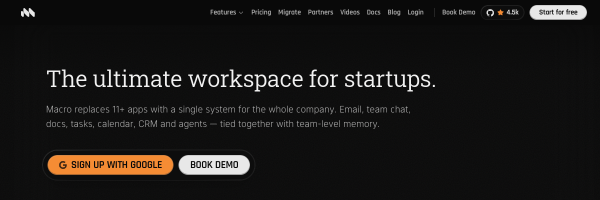
Open-source unified workspace and operating system unifying email, team chat, CRDT docs, Linear-style tasks, CRM, and AI agents with shared team memory.
Macro is an open-source, all-in-one team workspace and modern operating system for startups and high-velocity engineering organizations. Engineered to eliminate the chaotic fragmentation of running separate tools for communication, documentation, project tracking, customer management, and email, Macro unifies Email + Messages + Docs + Tasks + Agents + CRM into a single lightning-fast interface with shared, team-level memory. Developed in NYC and Toronto and built on a high-performance SolidJS frontend and 167 modular Rust crates, Macro connects every workspace object into a bidirectional graph so teams and autonomous AI agents never have to switch contexts or stitch together brittle Zapier integrations.
j, k, and e keyboard triage, native split-window multitasking, AI-driven PDF attachment parsing, and direct in-chat email drafting and sending./task), checklist item, or channel mention, preserving complete audit trails from inception to GitHub PR merge.| Capability / Dimension | Macro All-in-One Workspace | Fragmented Stack (Slack + Notion + Linear + Superhuman + HubSpot) |
|---|---|---|
| Data Architecture | Unified bidirectional graph across all entities | Isolated data silos connected via webhook / Zapier glue |
| Core Performance Stack | SolidJS + Rust (167 crates) + CRDTs | Heavyweight Electron wrappers & independent backends |
| AI Team Memory | Team-wide memory synthesized nightly across chat, mail, docs, and calls | Fragmented per-app chat history with zero cross-tool memory |
| Model Context Protocol (MCP) | Native MCP Server with near 100% UI action coverage and zero rate limits | Incomplete, proprietary third-party connectors with per-app rate limits |
| Task-to-Conversation Coupling | Instant 1-click creation from email, chat, or doc with full provenance | Manual copying of URLs, screenshots, and context between Slack and Jira/Linear |
| Licensing & Privacy | 100% Open Source (AGPL-3.0), self-hostable, SOC 2 Type II certified | Closed-source SaaS proprietary lock-in with multi-seat billing stacks |
Get started with the hosted cloud version or point your AI coding assistant directly at Macro’s MCP server:
# Connect Claude Code or Cursor to Macro via HTTP MCP transport
claude mcp add --transport http macro https://mcp-server.macro.com/mcp
Configure Macro in your local .mcp.json file:
{
  "mcpServers": {
    "macro": {
      "url": "https://mcp-server.macro.com/mcp"
    }
  }
}
For self-hosting the full local stack with Pulumi and Docker Compose:
# Clone the repository
git clone https://github.com/macro-inc/macro.git
cd macro

# Spin up local development infrastructure
docker compose up -d
| Frontend Architecture | SolidJS, Lexical, Loro CRDTs, Tauri (Desktop) |
|---|---|
| Backend Architecture | Rust (167 crates), Cloudflare Workers & Durable Objects, PostgreSQL |
| Supported Platforms | Web, macOS, Windows, Linux, iOS (App Store) |
| Security & Compliance | SOC 2 Type II Certified, ISO 27001 Certified, Zero LLM Data Retention |
| License | Open Source (GNU AGPLv3) |
| MCP Server Endpoint | https://mcp-server.macro.com/mcp |
| Official Repository | github.com/macro-inc/macro |
| Official Website | https://macro.com |
| Documentation | https://docs.macro.com |
Instead of maintaining five separate SaaS subscriptions with disconnected data, Macro combines email triage, team messaging, issue tracking, and collaborative docs into a single unified window. Everything shares the same bidirectional graph, meaning an email can become a Linear-style task or be @mentioned in team chat with zero copy-pasting.
Macro runs an automated nightly synthesis across all team interactions—channel discussions, direct messages, sent/received emails, meeting call transcripts, and closed tasks. This structured memory is exposed to external agents via the Model Context Protocol (MCP), allowing coding agents to know team priorities without human briefing.
Yes. Macro is fully open-source under the GNU AGPLv3. Organizations can self-host the entire infrastructure using the provided Docker Compose and Pulumi definitions on their own cloud or bare-metal servers.
Macro is 100% open source under the AGPLv3 license, not open-core. All 167 Rust crates, frontend SolidJS applications, and service layers are available in the public repository.